
Arthritis is more than occasional joint pain or stiffness. It is a broad term used for more than 100 conditions that can affect the joints, surrounding tissues, and, in some types, other parts of the body. While arthritis becomes more common with age, arthritis is not simply a normal or unavoidable part of getting older.
For some people, arthritis develops gradually as joints and surrounding tissues change over time. For others, the immune system plays a major role in causing inflammation and joint damage. Understanding the type of arthritis you have is important because rheumatoid arthritis treatment and osteoarthritis treatment are very different.
If you are experiencing persistent joint pain, swelling, stiffness, or difficulty moving, it is worth finding out what is causing your symptoms rather than simply assuming you have "normal aging."
In this guide, we will explain common arthritis symptoms, the difference between rheumatoid arthritis and osteoarthritis, important arthritis risk factors, treatment approaches, and why early arthritis treatment can make a meaningful difference in your long-term health and quality of life.

What Is Arthritis?
Arthritis refers to a group of conditions that affect the joints. A joint is where two or more bones meet, allowing your body to move.
Different forms of arthritis have different causes.
Some types involve inflammation caused by an abnormal immune response. Others involve changes to cartilage, bone, and other tissues within a joint. Some types can also affect areas outside the joints.
Two of the most commonly discussed forms are:
Osteoarthritis (OA)
Rheumatoid arthritis (RA)
Although both can cause arthritis pain, stiffness, and swelling, they are fundamentally different diseases.
That distinction matters because the right treatment depends on identifying what is actually causing your symptoms.
Common Arthritis Symptoms
Arthritis symptoms can vary significantly depending on the type of arthritis, which joints are affected, and how active the disease is.
Common symptoms include:
Joint pain
Joint stiffness
Swelling
Tenderness
Reduced range of motion
Warmth around an affected joint
Difficulty performing everyday activities
Fatigue in some inflammatory forms of arthritis
Some people notice symptoms primarily in one joint, such as a knee. Others develop symptoms in several joints.
The timing and pattern of your symptoms can provide important clues.
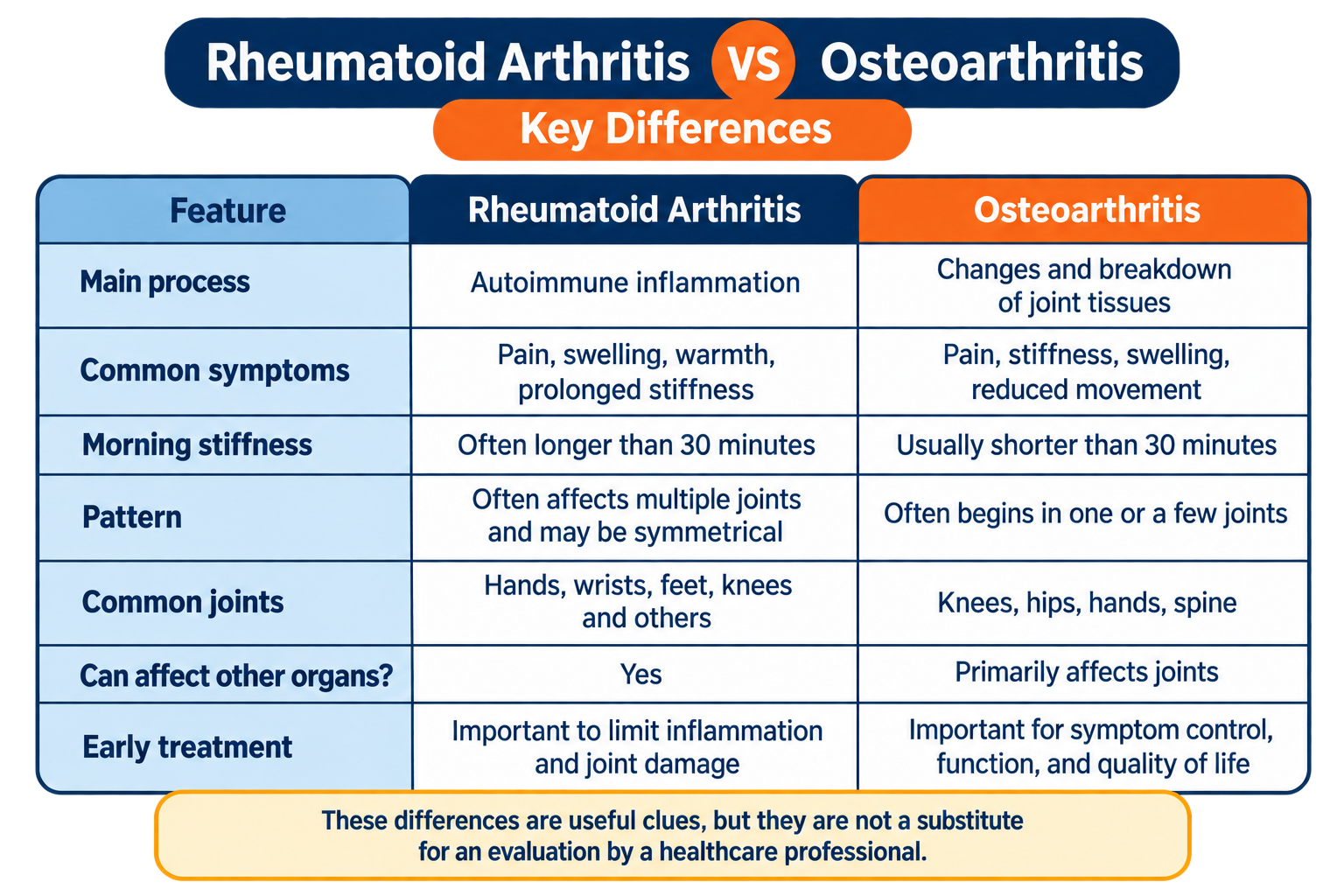
For example, stiffness that occurs after sitting or resting and improves relatively quickly may be more typical of osteoarthritis. On the other hand, prolonged morning stiffness, swelling, warmth, and symptoms affecting multiple joints can be signs of inflammatory arthritis such as rheumatoid arthritis.
However, symptoms can overlap between different conditions. That is why symptoms alone should not be used to diagnose arthritis.
Rheumatoid Arthritis vs Osteoarthritis
One of the most common questions people ask is:
What is the difference between rheumatoid arthritis and osteoarthritis?
Although both conditions can cause joint pain and stiffness, the underlying processes are different.
Rheumatoid Arthritis
Rheumatoid arthritis is a chronic autoimmune disease.
In RA, the immune system mistakenly attacks the body's own tissues, particularly the lining of the joints. This causes ongoing inflammation that can damage cartilage, bone, and other joint structures. RA can also affect organs and tissues outside the joints, including the lungs, heart, eyes, skin, and blood.
Common signs of rheumatoid arthritis include:
Pain and swelling in multiple joints
Tender or warm joints
Morning stiffness that typically lasts longer than 30 minutes
Symptoms that may affect both sides of the body
Fatigue
Weakness
Occasional low-grade fever
Loss of appetite
RA commonly affects the hands, wrists, and feet, although it can affect many other joints.
One important point is that rheumatoid arthritis is not simply a disease of "old age." It can occur in adults at different ages.
Osteoarthritis
Osteoarthritis is the most common form of arthritis. It involves changes and breakdown of tissues within a joint, including cartilage, bone, tendons, ligaments, and the joint lining.
Common osteoarthritis symptoms include:
Joint pain, particularly with activity
Stiffness after resting
Stiffness that is usually brief in the morning
Swelling
Reduced joint movement
A feeling of instability
Grinding or clicking sensations, particularly in affected knees
Osteoarthritis commonly affects the:
Knees
Hips
Hands
Spine
Knee osteoarthritis is particularly common and can make activities such as walking, climbing stairs, standing from a chair, or exercising more difficult.
Importantly, osteoarthritis is also not simply "wear and tear." The condition involves complex changes to multiple tissues within the joint.
Why Early Arthritis Treatment Matters
One of the most important things to understand about arthritis is that early evaluation can matter, particularly when inflammatory arthritis is suspected.
This is especially true for rheumatoid arthritis.
RA can cause joint damage as the disease progresses, and damage that has already occurred generally cannot simply be reversed. Early diagnosis and treatment can help control inflammation, prevent or slow joint damage, and improve a person's ability to function.
That is why rheumatoid arthritis early treatment is such an important part of managing the disease.
The goal is not simply to make you feel better temporarily.
The broader goals of rheumatoid arthritis treatment include:
Controlling inflammation
Reducing pain and swelling
Preventing or slowing joint damage
Maintaining mobility
Improving daily function
Supporting quality of life
Achieving remission or low disease activity when possible
If you have persistent joint swelling, prolonged morning stiffness, or symptoms involving several joints, do not wait indefinitely hoping the symptoms will disappear on their own.
A rheumatologist can help determine whether your symptoms are related to rheumatoid arthritis, osteoarthritis, another inflammatory arthritis, or a different condition entirely.
How Is Arthritis Diagnosed?
There is no single test that can diagnose every type of arthritis.
Your healthcare provider may consider several pieces of information, including:
Medical history
Your doctor may ask:
When did your symptoms begin?
Which joints hurt?
Is the pain constant or intermittent?
How long does your morning stiffness last?
Do your joints swell?
Do symptoms affect both sides of your body?
Are you experiencing fatigue or other symptoms?
Does arthritis run in your family?
Physical examination
Your healthcare provider may examine your joints for:
Swelling
Tenderness
Warmth
Range of motion
Joint stability
Other signs of inflammation
Blood tests
Blood tests may be useful when inflammatory or autoimmune arthritis is suspected.
For rheumatoid arthritis, tests may include markers such as rheumatoid factor and anti-CCP antibodies, along with tests that measure inflammation.
However, there is no single blood test that can definitively diagnose rheumatoid arthritis. Diagnosis involves the overall clinical picture.
Imaging
Depending on your symptoms, your provider may recommend X-rays, ultrasound, MRI, or other imaging.
The goal is to understand what is happening inside and around the joint and to look for evidence that supports a particular diagnosis.
Rheumatoid Arthritis Treatment
Because rheumatoid arthritis is an autoimmune inflammatory disease, treatment often focuses on controlling the underlying disease process rather than simply treating pain.
Doctors may use disease-modifying antirheumatic drugs (DMARDs) to slow disease progression and reduce the risk of joint damage. Biologic medications and targeted therapies may also be considered depending on the individual situation.
Treatment may also include:
Physical therapy
Occupational therapy
Exercise
Lifestyle changes
Anti-inflammatory medications
Corticosteroids in certain situations
Regular monitoring
The specific treatment plan should be individualized based on your symptoms, disease activity, other medical conditions, medications, and treatment response.
What About Prednisone for Rheumatoid Arthritis?
Prednisone is a corticosteroid that can reduce inflammation quickly.
In rheumatoid arthritis, corticosteroids may sometimes be used as short-term treatment when inflammation needs to be controlled while longer-term treatment begins working, or during certain disease flares.
However, prednisone is not a medication that should be started, adjusted, or stopped on your own.
Long-term corticosteroid use can cause significant side effects, which is one reason clinicians generally aim to use the lowest effective dose for the shortest appropriate duration.
If you are already taking prednisone, talk with your healthcare provider before changing the dose or stopping it. Depending on the dose and duration of treatment, suddenly stopping corticosteroids can be unsafe.
Osteoarthritis Treatment
Osteoarthritis treatment focuses on reducing pain, improving function, protecting mobility, and supporting quality of life.
Treatment may include:
Regular physical activity
Strengthening exercises
Range-of-motion exercises
Physical therapy
Weight management when appropriate
Pain-relieving medications
Topical treatments
Braces or supportive devices
Injections in selected situations
Surgery for severe disease when other approaches are not effective
For knee osteoarthritis, strengthening the muscles surrounding the knee can help support joint function. Low-impact activities such as walking, cycling, swimming, or water-based exercise may also be useful for many people.
Your exercise plan should be appropriate for your symptoms and physical condition, particularly if pain is severe or your joint feels unstable.
Arthritis Inflammation and Lifestyle
Medical treatment is important, but lifestyle can also play a role in arthritis management.
For inflammatory arthritis, lifestyle changes should be viewed as a complement to medical treatment, not a replacement for it.
A helpful framework is to look at several areas of daily life:
Nutrition
Exercise
Sleep
Stress management
Relationships and social support
Medication adherence and regular medical care
A Mediterranean-style eating pattern is one example of a dietary approach that emphasizes vegetables, fruits, whole grains, legumes, nuts, fish, and other minimally processed foods.
It can be helpful to reduce excessive intake of highly processed foods and sugar-sweetened beverages as part of an overall healthy eating pattern.
The goal is not perfection.
Instead, focus on sustainable changes that you can maintain over time.
Vitamins and Supplements for Rheumatoid Arthritis
People with rheumatoid arthritis frequently ask which vitamins they should take.
There is no universal supplement regimen that is appropriate for everyone with RA.
One important nutrient to discuss with your healthcare provider is vitamin D. Your doctor may recommend checking your vitamin D level and addressing a deficiency when present.
Other nutrients, including vitamin B12, folate, vitamin C, and vitamin E, may be important depending on your diet, medications, nutritional status, and individual needs.
For people taking methotrexate, folic acid supplementation is commonly prescribed as part of treatment to help reduce certain side effects.
Omega-3 fatty acids are another supplement that people with inflammatory arthritis sometimes ask about.
Before adding supplements, discuss them with your healthcare provider. More supplements are not necessarily better, and supplements can interact with medications or be inappropriate for certain medical conditions.
Arthritis Risk Factors
Arthritis risk factors vary depending on the type.
For osteoarthritis, factors associated with increased risk include:
Increasing age
Previous joint injury
Repetitive stress on a joint
Family history
Obesity or overweight
Certain joint abnormalities
For rheumatoid arthritis, risk factors and associations include:
Family history and genetic factors
Smoking
Certain environmental exposures
Female sex
Increasing age
Some other health conditions and exposures
Importantly, having a risk factor does not mean you will definitely develop arthritis. Likewise, people can develop arthritis without having an obvious risk factor.
Can Arthritis Be Prevented?
Not every type of arthritis can be prevented.
However, there are steps that may reduce risk or help you manage symptoms and maintain function.
These include:
Staying physically active
Maintaining a healthy weight when appropriate
Avoiding smoking
Protecting joints from preventable injuries
Managing other health conditions
Eating a balanced diet
Getting adequate sleep
Seeking medical evaluation when symptoms persist
For people who already have arthritis, early management can help reduce the impact of symptoms on daily life.
Arthritis and Quality of Life
Arthritis can affect much more than your joints.
Persistent pain and stiffness can make it harder to:
Exercise
Work
Sleep comfortably
Cook
Drive
Climb stairs
Participate in hobbies
Spend time with family and friends
Inflammatory arthritis can also cause fatigue and symptoms beyond the joints.
This is why arthritis treatment should not focus only on a pain score. The bigger goal is helping you maintain your ability to live your life.
With appropriate diagnosis, treatment, self-management, and ongoing medical care, many people with arthritis can remain active and productive.
When Should You See a Rheumatologist?
Consider speaking with a healthcare professional if you have:
Persistent joint pain
Repeated joint swelling
Morning stiffness lasting more than 30 minutes
Pain affecting several joints
Symptoms affecting both sides of the body
Warm or tender joints
Unexplained fatigue along with joint symptoms
Symptoms that interfere with work or daily activities
Symptoms that keep returning or worsening
A rheumatologist specializes in diagnosing and treating arthritis and other musculoskeletal and autoimmune conditions.
The sooner the cause of persistent symptoms is identified, the sooner an appropriate treatment plan can begin, particularly when inflammatory arthritis is involved.
Frequently Asked Questions About Arthritis
-
Common arthritis symptoms include joint pain, stiffness, swelling, tenderness, warmth, and reduced range of motion. Symptoms vary depending on the type of arthritis. Rheumatoid arthritis may also cause fatigue, weakness, fever, or symptoms affecting multiple joints.
-
Rheumatoid arthritis is an autoimmune disease in which the immune system attacks joint tissues, causing inflammation. Osteoarthritis involves changes and breakdown of tissues within the joint. Their symptoms can overlap, but their causes and treatment approaches are different.
-
There is currently no cure for rheumatoid arthritis, but effective treatments can control disease activity, reduce inflammation, prevent or slow joint damage, and help people maintain their quality of life.
-
Yes. While there is currently no cure for osteoarthritis, symptoms can often be managed through physical activity, strengthening exercises, weight management when appropriate, medications, physical therapy, supportive devices, and other treatments. Severe cases may sometimes require surgery.
-
You should consider an evaluation if joint pain or stiffness persists, keeps returning, causes swelling, affects several joints, lasts for a prolonged period in the morning, or interferes with your daily activities. Early evaluation is particularly important when rheumatoid arthritis or another inflammatory arthritis may be involved.
Arthritis is not one single disease.
Osteoarthritis and rheumatoid arthritis can both cause arthritis pain, stiffness, and swelling, but they have very different underlying causes and treatment approaches.
That is why getting the right diagnosis matters.
If your joints are persistently painful, swollen, stiff, or limiting your daily activities, do not automatically assume it is simply aging. Early evaluation can help identify inflammatory arthritis and other conditions that may require specific treatment.
And if you already have rheumatoid arthritis, remember that treatment is about more than simply managing pain. The goal is to control inflammation, protect your joints, maintain function, and support your long-term quality of life.
Lifestyle changes, nutrition, exercise, sleep, stress management, and appropriate supplements can all be part of a comprehensive approach, but they should work alongside appropriate medical treatment, not replace it.
If you are in North Carolina and looking for a rheumatologist who can provide a comprehensive evaluation and help you understand your symptoms, you can book an appointment with Empowered Arthritis and Rheumatology Center. The practice is located in Cary, North Carolina, and provides rheumatology care for arthritis and autoimmune conditions.
For patients outside North Carolina or outside the United States who still want education, guidance, and support, you are also welcome to join the free, exclusive community. You can connect with Dr. Subedi, interact with other rheumatoid arthritis warriors who understand what you are going through, and participate in future group calls covering real-life RA challenges, treatment options, lifestyle strategies, flare management, medications, and more.
You can also explore these free resources:
📘 Grab a copy of The Holistic Rheumatoid Arthritis Guide for step-by-step support
🥤 Download my FREE Rheumatoid Arthritis pain relief smoothie recipe
